For about a thousand years, the people of the Ben Ezra Synagogue in Old Cairo kept a room with no window and no door.
You reached it by climbing a ladder in the gallery and squeezing through a hole in the wall. Inside there was nothing but paper: fragments by the hundred thousand, heaped and matted and dusty, stuck to one another, living with insects. Nobody tidied it. Nobody burned it. They only ever added.
That room is the Cairo Geniza, and it is the largest and most diverse collection of medieval manuscripts in the world. Around 400,000 fragments, in Hebrew, Arabic and Aramaic, on vellum and paper, papyrus and cloth, spanning the sixth to the nineteenth centuries. It exists for one reason. In Jewish practice a worn-out text that carries the name of God is not destroyed. It is set aside in a geniza, a storeroom, and later carried out and buried in a cemetery. That was the custom: collect, then bury. Here the burying never happened. Generation after generation simply kept carrying the papers up the ladder and leaving them there. Reverence did the work that careful preservation usually does. Nobody was trying to save anything. They were only refusing to throw it away.
So what survived is not the grand and official record. It is the ordinary one. Letters between merchants. Court papers and contracts. Shopkeepers' account books and children's school exercises. Wages paid to labourers, in what is the largest set of medieval Islamic day-wage records anywhere. More than 2,500 fragments of medicine: prescriptions, druggists' notes, doctors' private notebooks. Records of a bookkeeping system using double entry that appears here in the eleventh century, before any known Italian version of it.
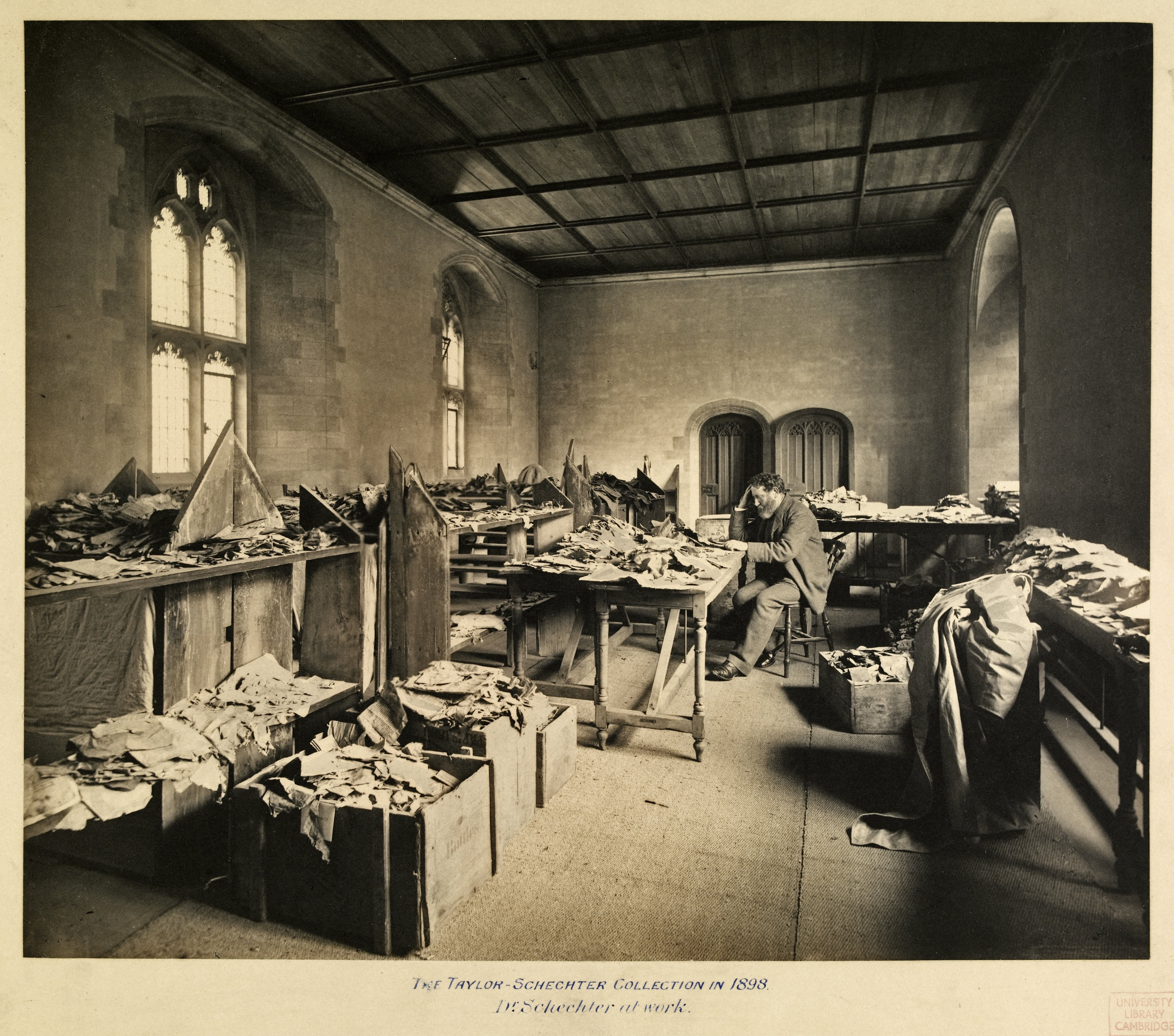
Because it was so ordinary, it turned out to be irreplaceable. In 1896 two identical-twin Scottish scholars, Agnes Lewis and Margaret Gibson, carried a few leaves home to Cambridge and showed them to Solomon Schechter. Among them he found the Hebrew original of the Book of Ben Sira, a wisdom text from the second century BCE that had been known only through Greek and Latin translations. He travelled to Cairo and had the greater part of the room sorted and carried away. Later readers matched other fragments to the Dead Sea Scrolls, and pieced back together the lost correspondence of the Khazar khaganate and a letter from a Jewish community in tenth-century Kyiv.
The scholar Shelomo Goitein spent a lifetime reading the heap and rebuilt a whole Mediterranean world from it, between 950 and 1250: some 35,000 named people, 450 trades, 450 goods, a map of trade running from Samarkand to Seville. One page of a single manuscript now often sits in three or four libraries, in different countries.
The geniza was emptied by the scholars who were eager for it, and it was never refilled. But it lasted a thousand years not because anyone guarded it. It lasted because a whole community, century after century, could not bring itself to burn a page with God's name on it. A book about it is called Sacred Trash, and that is exactly right. The quiet ones lasted anyway.
Sources:
- Wikipedia, "Cairo Geniza" (compiling S. D. Goitein, A Mediterranean Society; A. Hoffman & P. Cole, Sacred Trash)
- Jeremy Norman's HistoryofInformation.com, "The Cairo Genizah, the Largest and Most Diverse Collection of Medieval Manuscripts in the World"
- Cambridge University Library Cairo Genizah Collection; Princeton Geniza Lab
Image: Solomon Schechter at work among the Genizah fragments, Cambridge, c. 1898. Public domain, via Wikimedia Commons.