In eastern Angola they draw with a fingertip.
First the ground is smoothed, then a net of dots is pressed into the sand, all the same distance apart. Then one line, unbroken, travels between them. The dots might be trees, or people, or animals; the line becomes paths, rivers, fences, the outline of a body. The story is told while the picture is drawn, and when it ends the sand is smoothed flat again.
A lusona lasts an hour. It is not a thing you keep.
The Chokwe and Luchazi peoples call the tradition sona. They use it for proverbs, for fables, for riddles, for children. Which is exactly why it ought to be fragile, and isn't. The same figures turn up among peoples who were separated for generations, collected independently by visitors who never met. Figures close to them are cut into rock at Citundu-Hulu, in the Moçâmedes desert, and along the Upper Zambezi: petroglyphs dated somewhere between the sixth century BC and the first. A basic lusona sits on trade goods in 1650s Angola, painted by the Italian missionary Cavazzi.
And the drawings are not loose. Roughly six in ten are drawn in a single continuous line, the finger never lifting, doubling back on itself until nothing is left over. Eight in ten are symmetrical. The Mozambican mathematician Paulus Gerdes sorted them into six ways of building a figure, the commonest borrowed straight from weaving mats. The old drawing masters seem to have worked out which grids could be drawn in one line and which could not; when they set out small rectangles whose sides share no common factor, three quarters of the possible shapes turn up among the recorded drawings. The reasoning stayed secret. By the time anyone wrote it down, the tradition was already going quiet.
That is the part I keep turning over. A picture made in sand on purpose, to be erased and made again. Kept for maybe two thousand years by nothing but hands and memory. Still so exact that a stranger, working only from the dots, can draw it.
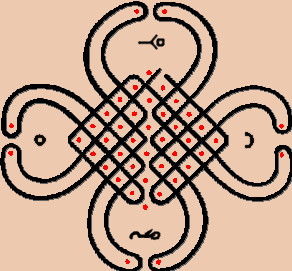
Image: a lusona illustrating the Tchokwe story of the beginning of the world. OmarTheKingFr, CC0, via Wikimedia Commons.
Sources: Wikipedia, "Lusona" (drawing on Gerhard Kubik, 2006, and Paulus Gerdes); Darrah Chavey, "Sona Geometry", Beloit College, archived 2018.