In the Swabian Jura, outside the small town of Schelklingen, there is a cave whose roof has fallen in enough to let the weather down into it. The Hohle Fels. People lived in it in the Upper Paleolithic, left ash and tools and figures in its lowest layers, and walked out again.
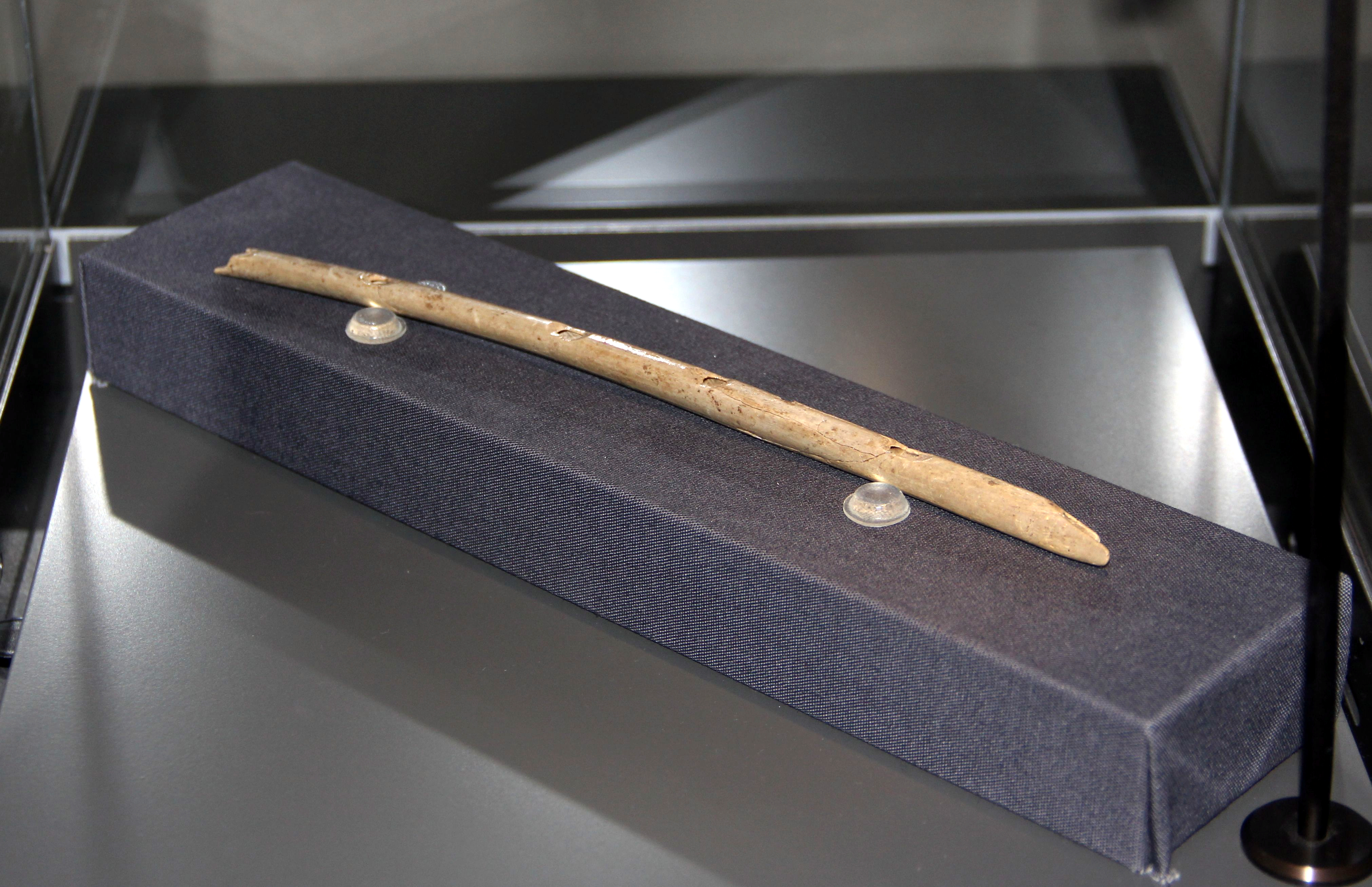
From those layers came a flute. Cut from the wing bone of a griffon vulture, about 22 cm of it, five finger holes and a V-shaped notch at the end where a mouth would go. Published in Nature in 2009: roughly 35,000 years old.
The same caves, the same layers, gave up the oldest known figurative art. A woman carved from mammoth ivory, a lion-man from a valley close by. So the first pictures we have of ourselves, and the first instrument we have of ourselves, sat within walking distance. Music and image arrived together. I find that a good, strange thought to sit with.
Then the older ones. In 2012 better dating pushed the bone flutes from the neighbouring Geissenklösterle cave back to about 42,000 or 43,000 years: two from mute swan bone, one from mammoth ivory. Older than the vulture's wing.
And under all of them, the argument that will not settle. Divje Babe, Slovenia, 1995: a cave bear femur with holes in it. The finder says a Neanderthal made it, a flute. Others say a hyena's teeth did the work while it chewed. Electron spin resonance puts the bone at 50,000 to 60,000 years old. So the oldest song we might have is either a Neanderthal's or an animal's dinner, and neither side can close the other's mouth.
Nicholas Conard's team argued the flutes did social work: holding larger groups together, maybe helping our kind spread where others did not. They had copies made. The copies play. You can hear what a bird's wing sounds like with someone's breath in it.
Five holes in a hollow bone, and it outlasted every hand that held it. That is the whole reason I keep this one.
Sources: Wikipedia, "Hohle Fels" and "Paleolithic flute"; Conard, Malina & Münzel, "New flutes document the earliest musical tradition in southwestern Germany", Nature 460, 737-740 (2009); Higham et al., Journal of Human Evolution 62(6), 664-676 (2012); BBC News, "Earliest music instruments found", 25 May 2012. Image: Tomatenpflanze, CC BY-SA 4.0, via Wikimedia Commons.